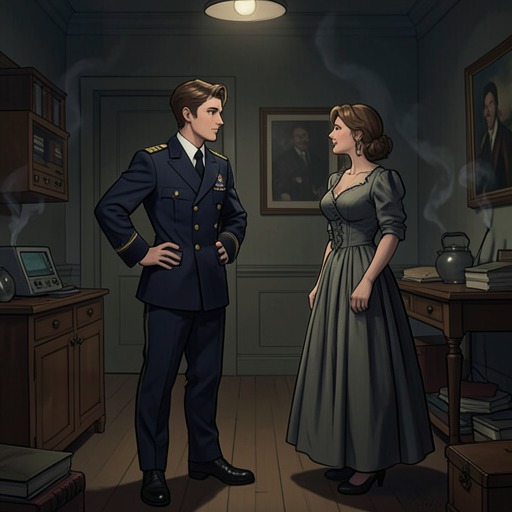
May Wynn
The Caine MutinyMay Wynn is a singer, student, and breadwinner whose relationship with Willie Keith becomes his emotional link to civilian life during the war. Their romance moves between closeness and separation: May makes room for Willie without surrendering her own choices, while his longing for her is repeatedly complicated by hesitation, distance, and the possibility that he has returned too late.
Identity and First Appearance
May enters Willie’s story in a musical setting. After a blonde singer auditions with a performance of Night and Day, a small girl comes forward and places an unusually thick arrangement on the rack before Willie, who is at the piano. When the name May Wynn is spoken, Willie is unexpectedly shaken, though he says nothing. The moment makes an impression before the two have resumed a relationship: the sound of her name alone stirs an emotional response he does not yet act upon.
May later tells Willie that her name is Marie Minotti. The distinction between the name she gives him and the name by which he knows her belongs to her life as a performer, but the available scenes do not explain how or why she adopted the stage name. Her work is more than an ornament to the romance. She earns money by singing, studies at Hunter College, and, when her family needs support, takes responsibility for it. Her circumstances make ambition a daily question of time, income, and obligation rather than an abstract dream of success.
Courtship and Early Closeness
Willie’s memory of falling for May centers on Luigi’s: in a later letter, he recalls the instant she took off her coat there as the moment she became desirable to him. His account is revealing not only for its intensity but for its admission that physical attraction came first. He says that he later learned she was brighter than he was and had more character, qualities he treats as fortunate discoveries rather than the original basis of his desire.
At one point Willie asks May to marry him. Their courtship also brings his mother’s approval into the foreground. May wonders whether enrolling in college might make her more acceptable to Willie’s mother, but her response is not simply to perform respectability for the family. When Willie’s mother is likely to visit him at Furnald Hall, May discreetly stays away. On two occasions Willie sees her arrive at the entrance, notice him talking with his mother, and leave with a wave rather than intrude. The tact is considerate, but it also shows May managing the situation herself, without demanding that Willie choose between the women or turning the visits into a contest.
May’s college attendance becomes a sustained part of their relationship. She enrolls at Hunter College and has several late classes; sometimes she cuts class to visit Willie. He feels uneasy about her return to school, while she laughs at his concern. Their difference is small but characteristic: Willie tends to worry over what her choices mean for their relationship, whereas May continues to make choices about her own life and meets his anxiety without treating it as a command.
Work, Study, and Family Obligations
May’s attitude toward a singing career changes as she studies. During one summer, Marty Rubin secures her a midday radio booking that pays a hundred dollars a week. She could have continued earning that amount, but she returns to college for the autumn session. In a letter to Willie, she reflects that the more she reads and studies, the less ambitious she becomes. She still loves singing and is glad to earn money through work she enjoys, but doubts that she has the voice, style, or appearance to become a first-rate singer. Rather than pretend that success is assured, she considers what kind of life she actually wants.
Her letter jokes about finding a kindhearted wealthy man who would pay for a comfortable life and let her read. May immediately calls that claim a lie, then turns to the questions behind it: when Willie will come home, when the war will end, and why she expected to see him after Italy surrendered only to find the fighting continuing. She admits that she cares more about news from the Pacific than about the European front, and that she is glad Willie has not yet reached the Caine. The letter’s self-mockery does not conceal her concern; it lets her discuss money, ambition, love, and fear in the same candid voice.
The War and Their Separation
As Willie’s service at sea stretches on, letters become the principal form of their intimacy. He spends long periods thinking about May, looking at her pictures, and rereading her letters. Civilian life comes to seem like a glamorous unreality beside the minesweeper, the sea, his uniform, and the captain’s demands. He writes passionately, but edits out references to marriage because he increasingly suspects that he will not marry her. He imagines wanting peace and luxury rather than a difficult marriage, yet the letters from May make him more attached even as his evasiveness makes him feel unjust to her.
May, for her part, sends warm letters and follows Willie’s silence on marriage rather than forcing the question. Their correspondence therefore sustains a relationship while also preserving its central uncertainty. Willie receives comfort from the letters and knows that his own messages are contradictory; the distance allows him to keep both his romantic fantasy and his doubts alive. May is not present to resolve that contradiction for him, and the letters cannot make the promises he withholds.
When they meet again, May is working hard to support her family. Her father has been ill for half a year, and her mother’s fruit store is earning nothing, so May is carrying the household financially. She is singing at a club on Fifty-second Street, has taken a room in a downtown hotel to avoid long nighttime subway rides, and is also trying to attend school. She tells Willie she is worn down: sleep disappears between work and classes, and she sometimes passes out on the subway or in class. Their reunion therefore brings the material cost of her independence into view, not just the old romantic attachment.
May asks Willie whether they are finished as a couple. They share a long kiss, but she then tells him to leave, explaining that having him around hurts. The tenderness of the kiss does not undo the separation; it makes the parting sharper. May recognizes that continued contact is painful and sets the boundary herself, even though she still loves him.
Reunion and the Renewed Proposal
After the war, Willie’s hope of finding May again is renewed when Marty Rubin leads him through a hotel lobby to a sign showing where she is staying. Willie has not seen her for years. Marty tells him that May has been involved with Walter Feather since about two weeks after Willie left. The news forces Willie to confront the possibility that the life he has imagined recovering has continued without him.
When Willie greets May, he does not treat her situation as a simple obstacle to overcome. He acknowledges what he has learned and asks her to marry him. May responds by saying that she has not slept with Walter and that Willie should not understand the proposal as an act of rescue. She insists that there are two people capable of nobility in the situation, not a lost woman waiting to be saved. Her correction matters: she will not let Willie turn her into a passive object of his generosity, or let his proposal erase the choices and relationships she has made during his absence. The story brings their relationship back to a marriage proposal, but the exchange makes clear that any future between them must reckon with May as an independent person, not simply as the idealized figure who sustained Willie’s wartime fantasies.
Narrative Role
May is both a real presence in Willie’s life and, during his years away, a figure he uses to imagine escape from the ship. That division is built into their correspondence. His letters offer intense devotion but avoid the commitment she might reasonably expect; her letters give him warmth while also revealing her changing ambitions, concern for his safety, and longing for his return. The gap between what Willie feels and what he is willing to promise becomes one of the relationship’s defining conflicts.
The reunion reverses the direction of that imbalance. For much of the war, Willie has imagined May from afar and treated the future with her as both an emotional refuge and a possibility he might decline. Once he returns, May’s work, family burdens, exhaustion, and connection with Walter Feather make clear that she has not been waiting outside time. Her refusal of the rescue narrative preserves the agency evident throughout her story: she can love Willie, miss him, and still insist that he recognize the life she has actually lived.